Sep 27, 2026Beauty Manufacturing Guides
Batch Consistency: Why Your Reorder Must Match Your First Order
The real test of a cosmetics factory is not the first batch — it is the fifth. Here is why batch consistency decides repeat purchases, and how to protect it before you commit.
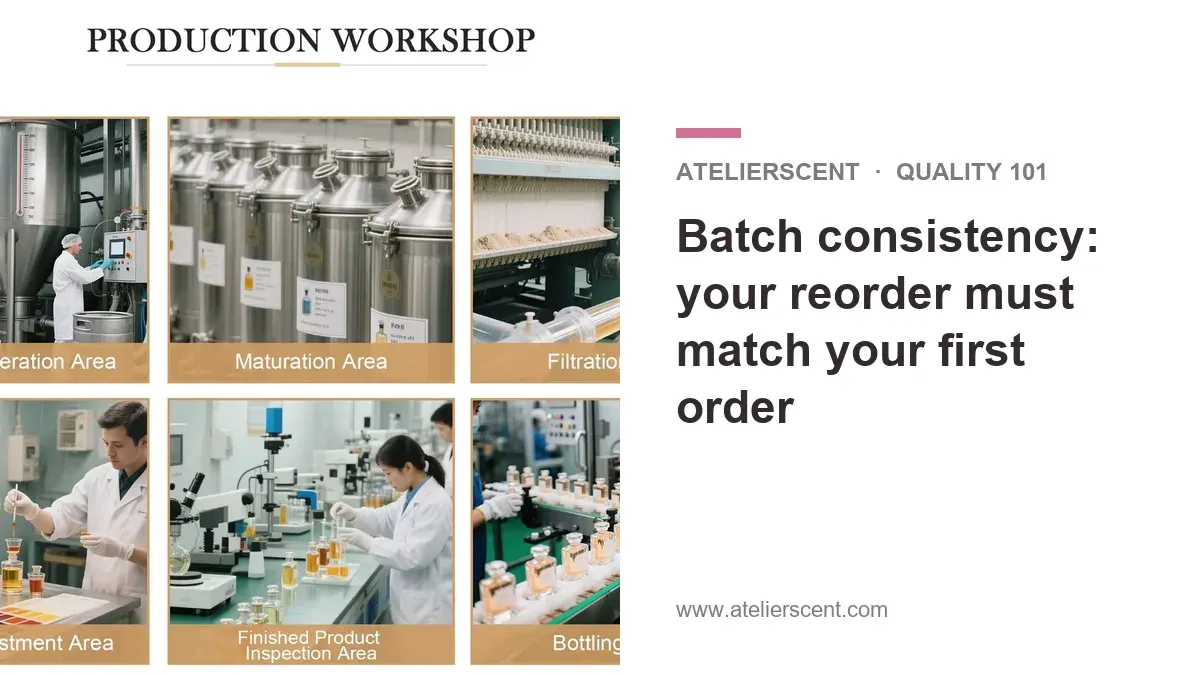
A cosmetics brand lives or dies on an unglamorous detail: whether the product a customer buys in month six is identical to the one they loved in month one. First batches are easy — every factory is careful when a new client is watching. Consistency across reorders is where manufacturing discipline shows, and it is the single biggest hidden factor behind repeat purchases.
What Customers Actually Notice
Customers rarely write reviews when a product is exactly as expected — but they notice instantly when it is not. A slightly different texture, a shade that drifts, a scent that changed: none of it may be objectively bad, and all of it erodes the trust that made the first purchase. In private label, that erosion lands on your brand, not your factory's.
Where Inconsistency Comes From
Batch drift usually traces back to process, not bad intent: raw materials swapped without notice, formulation steps adjusted to save time, packaging sourced from a new supplier, or quality checks skipped under deadline pressure. None of these show up in a sample. They show up — slowly — across the reorders that follow.
The Standard That Prevents Drift
This is what manufacturing standards are for. Good Manufacturing Practice exists precisely to make batch one and batch ten identical: controlled raw materials, documented processes, trained personnel, and quality checks at defined stages. When a factory works under strict ISO 22716 and GMP standards, consistency is not a promise — it is the operating system.
Ask a factory how it keeps batch five identical to batch one. The answer — specific or vague — tells you everything about the next two years.
Protect Consistency in Your Agreement
You can lock consistency into the relationship with three practical moves. First, keep your confirmed sample as the reference every order is measured against. Second, ask whether raw materials or packaging sources will change between runs — and require notice if they do. Third, make reorder quality a stated expectation, not an assumption; serious factories welcome it, because it signals you plan to reorder.
The Reorder Is the Real Partnership
A factory that delivers the same product every time is worth more than one that dazzles once. That is why low MOQ matters beyond the first order: it lets you test the reorder behavior early — place a small second order and see whether what arrives matches what you confirmed. At Atelierscent, products are manufactured under strict ISO 22716 and GMP standards, with quality controlled at every stage, and low MOQ that makes those early reorders easy. To discuss a range built for consistent reorders, contact Diana Dong (Sales Director) at Diana@vipetsy.com.