Oct 28, 2026Beauty Manufacturing Guides
Sheet, Clay, Sleep, Peel-Off: Face Mask Types Explained
"Face mask" is an umbrella over several very different products. Here are the four main types — what each does, when customers reach for it, and what that means for your line.
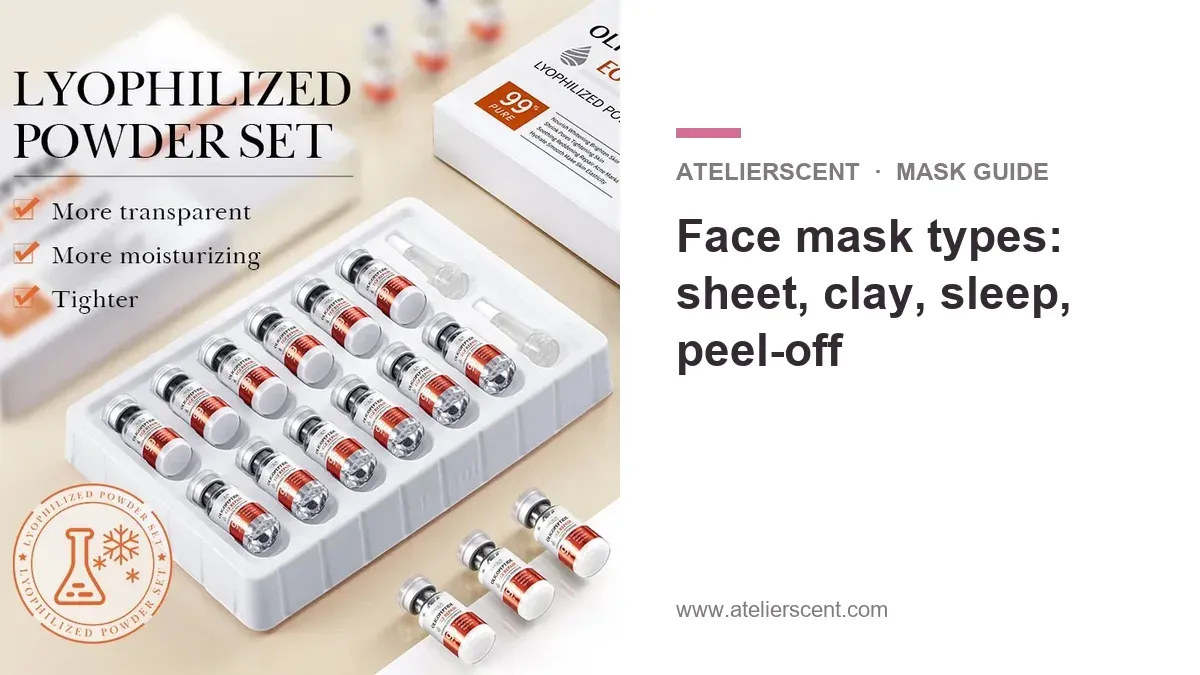
Ask ten customers what a face mask is and you may get ten different answers — and all of them can be right. "Mask" is an umbrella over a family of products that work in different ways, fit different moments of the week, and attract different buyers. We have argued before that face masks deserve a place in a first skincare range; if you agree, the first step is knowing the family. Here are the four main types, in plain language.
Sheet Masks: The Single-Use Ritual
A sheet mask is a fabric or hydrogel sheet soaked in serum, worn for a short session and discarded. The single-dose format is the selling point: it is mess-free, precisely portioned, and feels like an occasion rather than a chore — which is why sheet masks dominate gifting and travel moments. For a brand, the format is a natural first mask: easy to explain, easy to display, and easy for a first-time mask buyer to say yes to.
Clay Masks: The Deep-Cleanse Classic
Clay masks are mineral pastes applied to the skin and rinsed off after they work. They are the classic weekly deep-cleanse habit, and they speak loudest to customers with oily or combination skin who want the fresh, thoroughly-cleaned feeling. One honest note for your product copy: clay masks can feel drying when overused, so guidance matters — a brand that explains how often to use a mask earns more trust than one that only says to use it.
Sleep Masks: The Overnight Workhorse
A sleep mask is a leave-on layer worn overnight, which makes it the lowest-effort member of the family: no timing, no rinsing, no extra step beyond the last one of the evening. It fits naturally at the end of an existing routine rather than replacing anything — an easy add-on for customers who already cleanse and moisturize, and a common answer for anyone who says they are too busy for masks. Our kojic acid brightening set, for example, includes one among its nine pieces for exactly that reason.
The four mask types are not competitors on a shelf. They answer different moments in a customer's week — and different questions in your range.
Peel-Off Masks: The Instant-Results Show
Peel-off masks are applied as a gel, left to dry, and removed in one satisfying piece. They deliver the most visible, most shareable moment of any mask type — the reveal is part of the product. That drama is also why they polarize: some customers love them for the instant-clean feeling, so honest usage guidance (gentle frequency, careful around delicate areas) keeps the experience fun instead of irritating.
Choosing Types for Your Line
The lesson of the family is to choose by your customer's moment, not to launch all four at once. A gift-friendly brand starts with sheet masks; a routine-focused brand adds a sleep mask; a deep-cleanse positioning points to clay. With low MOQ private label manufacturing — free logo and packaging design, production under strict ISO 22716 and GMP standards — testing one type before the next is an affordable way to learn which moment your customers actually want you for.
Pick Your First Mask
Tell Diana Dong, Sales Director, at Diana@vipetsy.com which moment your brand wants to own, and get a quote for the mask type — or types — that fit it.