Beauty Manufacturing Guides
Lead Time Questions, Answered Honestly
"How long does it take?" is the question every buyer asks — and the honest answer is a structure, not a slogan. Here is the timeline framework, and how to get your own dates.
Question-and-answer number three takes on the hardest one: "how long does it take?" The dangerous answer is a confident single number recited from memory. The honest answer is a structure — because real lead time depends on the product, the order size, the season, and how quickly decisions come back from your side. What we can give you honestly is the framework, so you know which stage you are in, what moves it, and how to get dates attached to your own order.
"So how long does production actually take?"
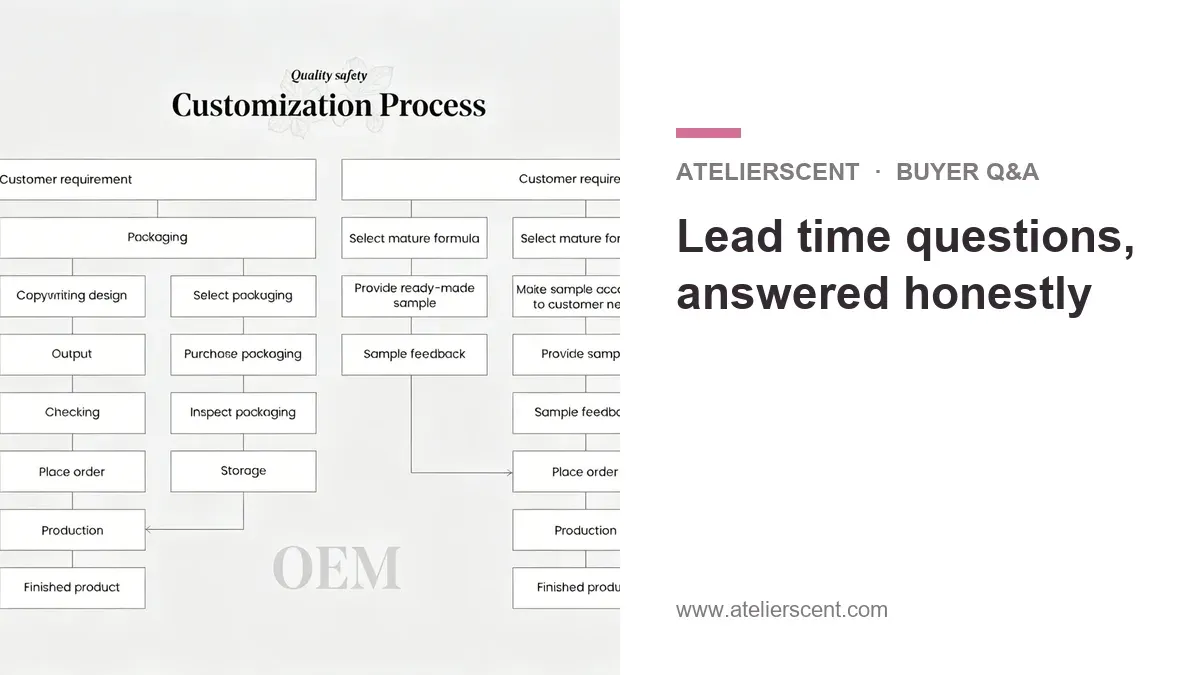
The timeline has named stages, and each one is knowable even when the total varies: quotation, design, sampling, mass production, quality control, shipment. This is the same path our customization-process article walks step by step. The stages are stable; the durations are not — they move with the product, the quantity and the season. So the straight answer to "how long" is: long enough to do it properly, and quotable as stage dates once your order is specific.
"What actually moves the timeline?"
Two kinds of things. The ones you control early — how clear your brief is, how fast design feedback comes back, how quickly shade and packaging decisions land — these can save more time than any factory can. And the ones the factory controls — production scheduling, quality control at each stage under ISO 22716 and GMP standards, and shipment arrangements. The single biggest timeline-stretcher in private label is a late change after samples are approved, which is why our sampling advice is to give real feedback at the sample stage — the cheapest moment to change your mind.
A timeline you cannot verify is a hope. A timeline with named stages and confirmed dates is a plan.
"How do I get dates I can plan around?"
Ask for stage-by-stage dates in writing, attached to your quote — quotation date, design window, sampling window, production window, shipment window — and put the reorder trigger on your calendar the day the first order ships, as our restock guide suggests. Then hold both sides to it: your decisions on time, the factory's stages on time. A partner that gives you named dates is showing you how it runs everything else.
"What about rush orders?"
Sometimes compression is possible, and an honest factory will say so — and then tell you exactly what gets squeezed. Here is the line we would hold: quality control is not the compressible part. If a rush means tighter scheduling and faster design turns, fine; if it means thinner checking before shipment, that rush will cost more than it saves. Ask what gets compressed before you agree to speed.
Get Your Timeline in Writing
Send your product brief to Diana Dong, Sales Director, at Diana@vipetsy.com, and ask for the stage-by-stage timeline with your quote — dates attached to your order, not a slogan attached to a brochure.