
Beauty Manufacturing Guides
When to Expand Your Shade Range
A shade range that is too narrow loses customers; one that is too wide buries them. Here is how to read the signals that say it is time to expand — and how to do it well.
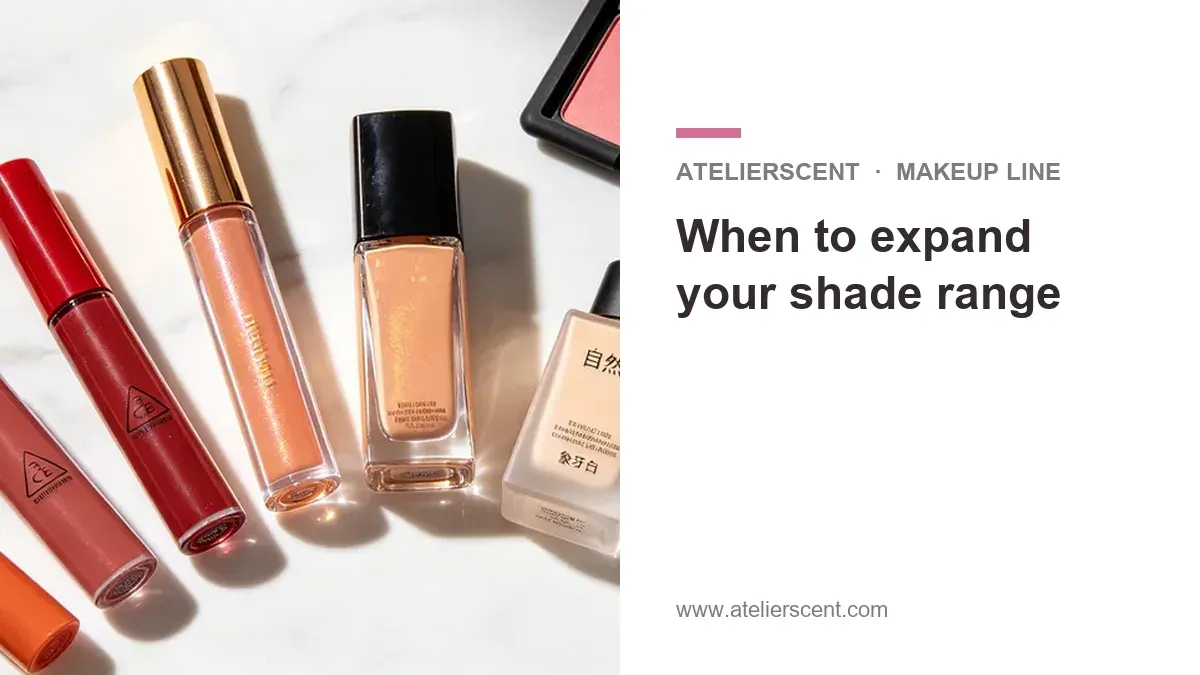
Shade range decisions look like product decisions, but they are strategy in disguise. We have written before about choosing shade ranges that fit your market — the short version being that a deliberate start beats the widest chart you can print. This article is about the other half of the question: how do you know when it is time to widen? The honest answer is that the signals arrive on their own, if you are watching. Here are the four that matter, and how to act on them without losing the plot.
Start Narrow, Start Right
A quick recap of the starting principle: shade breadth should match your market, not your ambition. A base range built around your customers' actual skin tones outperforms a chart that guesses at everyone; a lip range can start expressive rather than exhaustive because lips are about self-expression, not personal matching. The mistake to avoid at the start is not "too few" — it is "random": shades that do not form a navigable ladder from light to deep with consistent undertones.
Four Signals It Is Time to Expand
The signals arrive as evidence, not vibes. One: the ends of your range sell through fastest — if your deepest and lightest shades are the first to go, the market is telling you the middle was covered but the edges were not. Two: the same question keeps arriving — "does this come in a deeper tone?" asked three different ways is one demand, repeated. Three: feedback shows mismatch rather than taste — complaints about oxidizing or pulling wrong are product signals, not preference. Four: you are entering a new market or climate whose customers were not in the original picture. Any one of these justifies an expansion conversation.
Expand in Families, Not Scatters
When the evidence says go, expand in families instead of scattering: extend the undertone ladder you already have, deepen both ends together, keep the naming logic continuous. A customer navigating your range should feel that the new shades live where they would expect them. This matters because a wide but disorganized chart loses customers too — choice only works when it is navigable.
Every shade is a promise to a person. Add shades when people — not charts — ask for them.
What Different Rhythms Look Like
Different categories expand on different rhythms, and that is normal. Base and powder shades expand slowly and deliberately, because each shade is a personal match; on the Atelierscent site, the loose setting powder carries twelve shades and the shimmer primer six — ranges wide enough to serve, tight enough to navigate. Lip products can run much wider much sooner, because expression rewards breadth — the hydrating lip gloss on our site exists in forty-nine shades. With low MOQ manufacturing, testing an added shade is a small bet rather than a line-wide commitment, and with packaging design handled in-house for free, the expanded range still reads as one brand.
Read Your Signals
Send your sell-through notes and customer questions to Diana Dong, Sales Director, at Diana@vipetsy.com, and get a quote for the shades your evidence is asking for — added in families, under one brand.