Oct 23, 2026Beauty Manufacturing Guides
The Beauty Supply Chain, Explained (And Where Your Factory Fits)
Ingredient suppliers, manufacturer, brand, retail, customer — here is how the beauty supply chain fits together, and why one-stop manufacturing is the shortcut for a first launch.
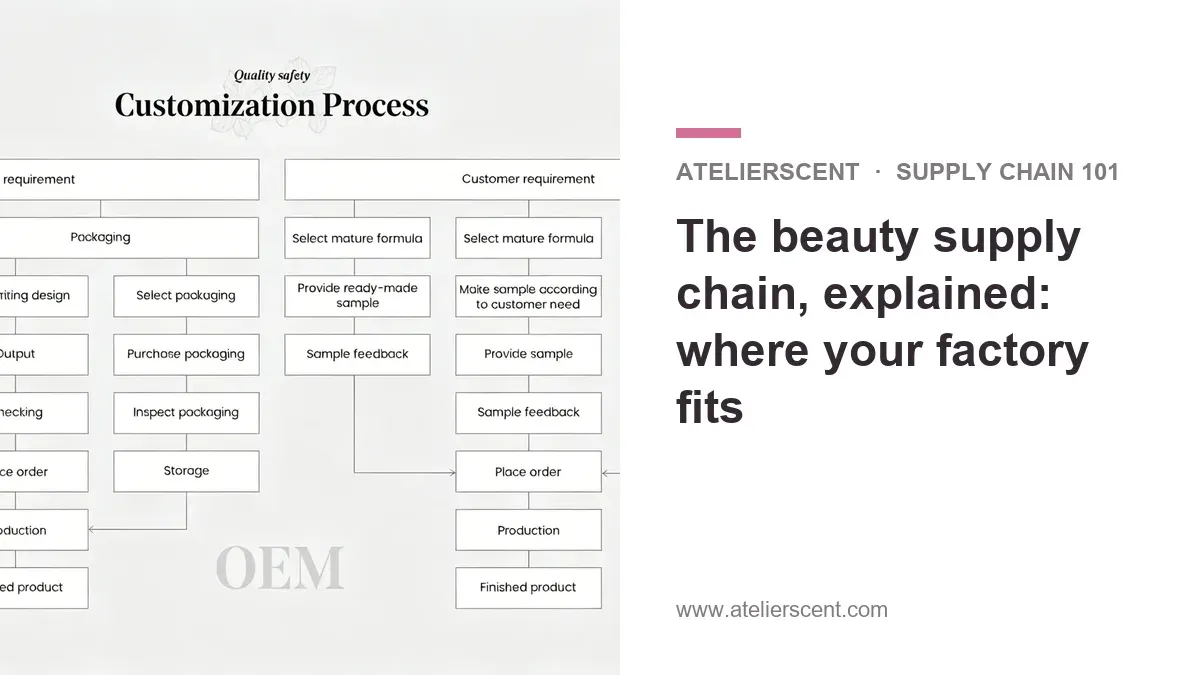
When a customer picks up a lipstick, that product has already passed through several hands: ingredient suppliers sold the raw materials, a manufacturer formulated and filled it, a brand owns the positioning and packaging, and a retailer put it on the shelf. Private label simply means you take the brand seat and a factory covers the industrial links behind it. Knowing the whole chain helps you decide which parts to own and which to delegate — and that decision shapes your budget, your timeline and your risk.
The Chain, Link by Link
Upstream sit the ingredient and packaging suppliers, who sell raw materials, actives and components. Next comes the manufacturer, where formulation, filling and quality control actually happen. The brand layer is yours: positioning, design direction, marketing story. Retail — whether that is your own online store, marketplaces or salons — connects the product to the final customer. Every link adds cost and lead time, and every handoff between them is a place where clarity can be lost.
Where a Private Label Brand Sits
You sit in the brand seat, and that is the right seat to own: it is the one customers remember. The industrial links are what a private label manufacturer covers for you — formulation, production and quality control under strict ISO 22716 and GMP standards. You make the positioning and design decisions; with free logo and packaging design, the visible brand layer is built with you rather than outsourced to yet another supplier.
Every extra handoff in a supply chain is a place where time, money and clarity can leak. One-stop manufacturing closes most of those leaks.
Why One-Stop Matters for a First Launch
Coordinating a separate designer, a separate formulator and a separate filler is how first launches slip and budgets stretch. At Atelierscent the service runs from design to shipment — one team carries your artwork, your products and your boxes out of the factory — and low MOQ keeps the first order lean, so you can launch, learn and reorder instead of overcommitting on day one.
What to Ask Before You Join the Chain
Put a prospective factory partner on the spot with four questions: Which standards do you produce under? Which categories can you cover — makeup, skincare, nail? What does your low MOQ let me realistically test? Who handles the design work? Straight, specific answers here tell you more about a partner than any catalogue, and they map exactly onto the links of the chain above.
Take Your Seat in the Chain
Tell Diana Dong, Sales Director, at Diana@vipetsy.com where your brand wants to sit and what you want to launch first. She will map design, production and shipment into one quote — so the only link of the chain you have to think about is the brand.