
Oct 26, 2026Beauty Manufacturing Guides
Sold Out? How to Plan Your Restock Like a Pro
Selling out is proof of demand — the restock decides whether that demand becomes a business. Here is how to plan a reorder: timing, batch consistency, and using low MOQ to refine.
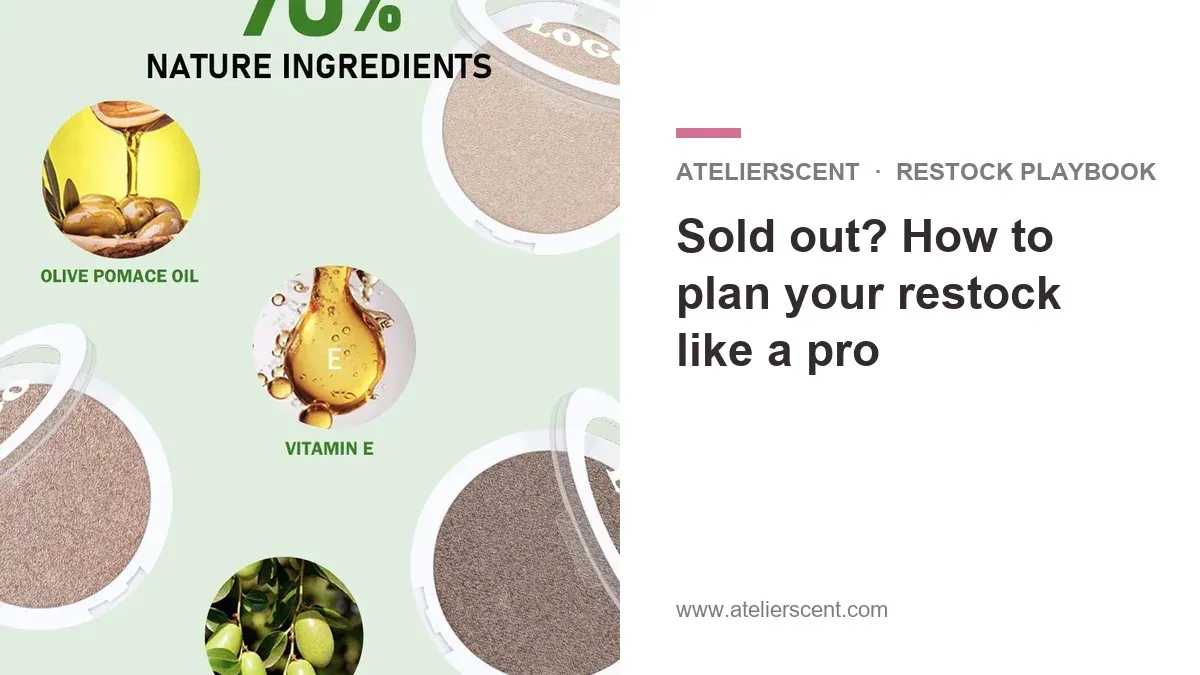
Selling out feels like success, and it is — but it is also a fork in the road. Handled well, an empty shelf becomes a smooth reorder that deepens customer habit; handled late, it becomes lost momentum while your customers buy elsewhere. The difference is planning. Professional brand owners treat the restock not as a panicked re-purchase but as a scheduled, informed decision — made before the shelf ever hits zero. Here is how to run yours that way.
Watch the Signals, Not Just the Shelf
A restock planned like a pro starts with attention. Track how quickly your stock is moving, how fast the last stretch sold, and how often customers ask when something will be back — those questions are demand data. Then work backwards: a reorder needs to arrive before you run dry, so the moment to place it is when you can see the end of your stock approaching, not when you are staring at it. Every day a bestseller sits unavailable, the customers who wanted it are forming other habits.
Brief Your Manufacturer Early
A restock to the same specification should be the easiest order you ever place: reference your original agreed product and packaging, confirm what stays the same, and list anything that genuinely needs to change. Briefing early also helps your partner schedule production sensibly — at Atelierscent, products are manufactured under strict ISO 22716 and GMP standards with quality checked at every stage, and a clearly briefed reorder slots into that process far more smoothly than a rushed one.
Batch Consistency Is the Real Product
As we covered in our article on batch consistency, customers expect the reorder to match the first order: same shade, same texture, same experience. That expectation is not vanity — it is the entire reason they come back. So before a restock ships, confirm that what changed (if anything) and what did not. Where something in the process must move, verify it against a sample rather than a memory. Consistency is what quietly converts a first purchase into a standing habit.
A restock is not just buying more. It is renewing the promise your first order made.
Use Low MOQ to Refine, Not Just Repeat
Low MOQ makes a restock more than a copy of the last order — it makes it a calibration. Expand the product that sold, trim the one that lagged, and if you want to test a companion product, attach it to the reorder instead of launching it cold. Because formulas and packaging carry your brand, each calibrated expansion builds recognition instead of starting over. Steady, evidence-led reorders are how a cautious first range grows into a confident full line.
Ready to Restock?
Send your original order details — what sold, what to adjust — to Diana Dong, Sales Director, at Diana@vipetsy.com, and get a reorder quote built around what your customers actually proved they want.